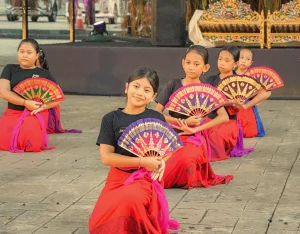
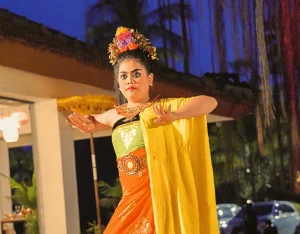
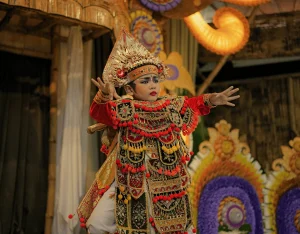
As dusk falls over a Balinese temple, the sound of gamelan fills the air. Dancers move with precision under flickering lamps, their eyes sharp yet serene, each gesture following an invisible rhythm. The audience sits in silence, watching stories older than memory unfold before them.
Balinese dance is more than performance it is devotion in motion, a bridge between the visible and the spiritual. Every movement and expression carries centuries of meaning, uniting ritual, myth, and beauty in one language of grace. What has allowed these sacred dances to endure and remain central to Bali’s cultural identity?
The Sacred Origins of Balinese Dance
The roots of Balinese dance reach deep into the island’s spiritual foundation. From ancient times, dance was created as an offering a prayer in movement meant to honor the gods, ancestors, and nature.
Each gesture (mudra), eye movement (seledet), and stance (agem) has symbolic meaning from expressing offering and courage to invoking purity. Even today, in temples and village courtyards, dance remains an act of worship expressed through motion.
Legong, Barong, and Kecak: The Soul of Balinese Performance
Among the many traditional forms, Legong, Barong, and Kecak stand as the heart of Bali’s dance heritage.
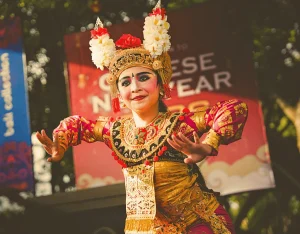
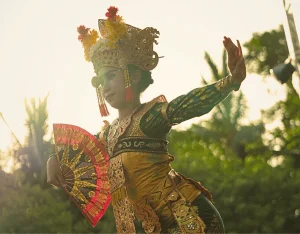
- Legong, graceful and refined, was born in royal courts during the 19th century. Traditionally performed by young girls, it combines intricate hand gestures and expressive eyes to tell tales of myth and devotion. Its precision and beauty represent discipline and harmony the essence of Balinese aesthetics.
- Barong depicts the eternal struggle between good and evil a dance of duality and balance. The lion-like Barong embodies light and protection, while his counterpart, Rangda, symbolizes darkness and chaos. The dance reminds viewers that peace arises not from victory, but from balance itself.
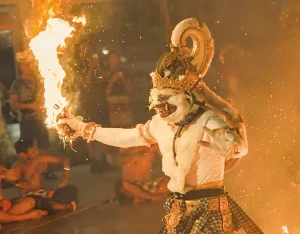
- Kecak, a powerful fusion of rhythm and storytelling, originated from ancient trance rituals (Sanghyang). In the 20th century, it evolved into a mass performance inspired by the Ramayana. Dozens of men chant “cak-cak-cak” in hypnotic rhythm, creating one of Bali’s most recognizable cultural experiences.
Together, these dances reflect the body, spirit, and sound of Balinese life graceful, communal, and deeply symbolic.
From Temples to the Global Stage
As Bali opened to the world, its sacred dances began to travel far beyond temple walls. In the early 20th century, cultural exchanges and festivals introduced global audiences to the island’s unique rhythm and storytelling.
While international exposure brought fame, it also brought a challenge preserving authenticity in new settings. Yet Balinese artists remain devoted to the rituals that ground their art. Before each show, blessings are still performed, ensuring that every performance remains a form of offering.
Today, traditional dances continue to thrive both in temple ceremonies and in modern theaters. Whether sacred or staged, they share one truth: Balinese dance is a living heritage, ever evolving but never losing its spirit.
Sawelas Nusantara: Where History Dances On
At Sawelas Nusantara, Bali’s dance legacy lives on with authenticity and reverence. Visitors can witness the grace of Legong, the strength of Barong, and the energy of Kecak, performed by skilled local artists who carry their ancestors’ knowledge with pride.
Each show is more than performance it’s a cultural bridge, helping travelers understand not just what they see, but what it means.
At Sawelas, dance becomes storytelling, history becomes motion, and the spirit of Bali continues to flow across generations.
📍 Visit us at Bali Collection, Jl. ITDC Nusa Dua Lot BC, Benoa, South Kuta, Badung, Bali.
📅 Check our Event Schedule and experience how history, faith, and art move together in perfect rhythm.
The past doesn’t fade it dances, reminding us that every step carries the soul of Bali forward.