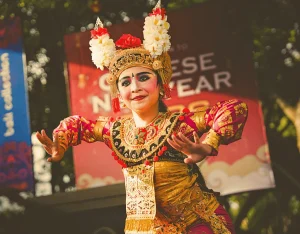
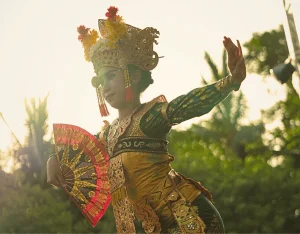
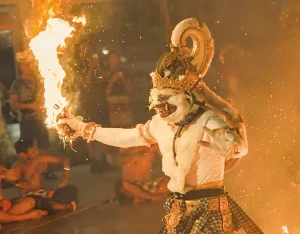
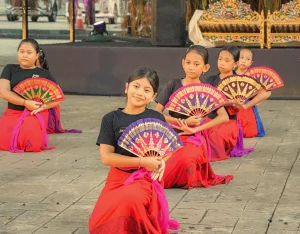
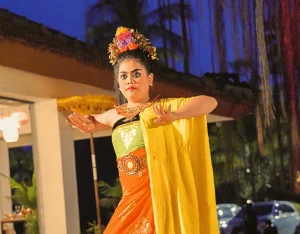
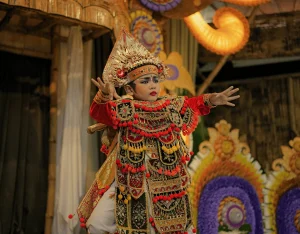
In Bali, Balinese dance moves quietly alongside ritual days, communal gatherings, and moments of celebration. Some dances unfold as sacred offerings, others as shared narratives, while some emerge as expressions of joy meant to be experienced together.
Rather than existing purely as spectacle, traditional Balinese dance carries distinct purposes shaped by context, time, and intention. How do these layers coexist within a single cultural tradition, and why does understanding them reshape the way we encounter Balinese culture today?
Dance as Sacred Offering: Wali
At its deepest level, Balinese dance functions as an offering. Wali dances are performed in temple spaces during ceremonial cycles, not for an audience, but for deities and ancestral spirits. Their purpose lies in devotion, balance, and spiritual continuity.
These dances follow strict conventions of space, movement, and timing. Dancers are not performers in the modern sense, but participants fulfilling a sacred responsibility. Beauty here is found not in display, but in sincerity of intention movement shaped by belief rather than applause.
Dance as Social Ritual: Bebali
Between the sacred and the celebratory lies bebali, where dance serves both ritual and social purposes. These performances often accompany ceremonies and convey moral reflection, historical memory, and shared values.
Unlike wali, bebali dances are meant to be witnessed and understood collectively. Audiences engage with the symbolic layers carried through gesture, dialogue, and music. Here, dance becomes a form of communication linking ritual meaning with communal understanding.
Dance as Celebration and Sharing: Balih-Balihan
Balih-balihan represents the most publicly visible layer of Balinese dance. Performed in festivals, cultural stages, and public spaces, these dances focus on enjoyment, cultural sharing, and celebration.
Though more accessible, balih-balihan remains grounded in discipline and tradition. Movements are refined through years of practice, and the values behind them continue to reflect Balinese philosophy. In this layer, dance becomes a meeting point between tradition and a wider audience.
Encountering Living Culture at Sawelas Nusantara
What makes Balinese dance unique is the way these layers coexist and support one another. Sacred belief, social memory, and cultural sharing flow together as one tradition. At Sawelas Nusantara, visitors are invited to encounter this living culture through performances, workshops, and cultural programs. Rather than presenting dance as spectacle alone, Sawelas offers space to observe practice, participate in learning, and understand the rhythm behind the art.
Through these experiences, Balinese dance is revealed as more than performanceit is a cultural language that moves between temples, communities, and shared spaces.
📍 Visit us at Bali Collection, Jl. ITDC Nusa Dua Lot BC, Benoa, South Kuta, Badung, Bali
📅 Check our Event Schedule and experience Balinese dance across its sacred, social, and celebratory expressions.
Culture speaks most clearly through purpose, not performance.