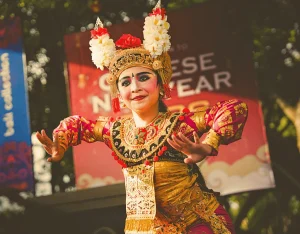
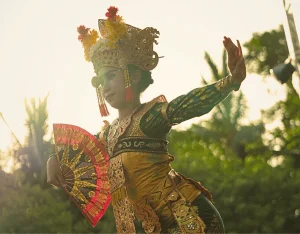
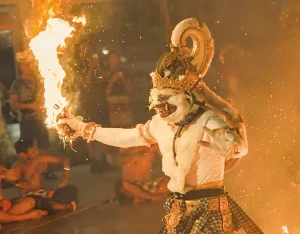
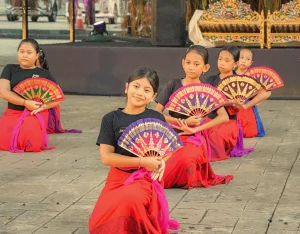
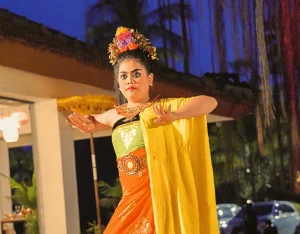
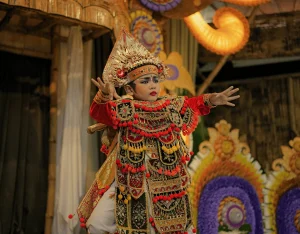
Across the island’s cultural landscape, time is felt before it is counted. Days unfold through ritual markers, ceremonial cycles, and moments of spiritual pause. Within this rhythm, traditional arts do not rush to keep up with the clock they move according to something deeper and older. Dance and music in Bali follow a rhythm shaped by sacred time rather than modern schedules. This difference can be felt immediately, even by those unfamiliar with Balinese culture. Why does artistic rhythm in Bali feel distinct, and how does ritual time continue to shape creative expression today?
Ritual Time as the Foundation of Artistic Rhythm
Balinese arts are rooted in a cultural understanding of time that differs from linear, modern systems. Ritual time is cyclical, guided by calendars such as Pawukon, temple anniversaries (odalan), and major ceremonial periods. These cycles determine when artistic activity intensifies, pauses, or becomes inward.
Rather than separating daily life from ritual life, sacred time weaves itself into artistic practice. Rehearsals align with ceremonies, performances respond to ritual needs, and moments of silence hold equal importance to expression. Art follows time not the other way around. This relationship forms the foundation of Balinese artistic rhythm.
Why Balinese Artistic Rhythm Feels Different
The rhythm of Balinese arts is shaped by repetition, patience, and collective focus. Movements unfold deliberately, music builds through layered patterns, and performances are allowed to develop fully. This creates an experience that feels immersive rather than rushed.
Unlike many contemporary performances designed around fixed durations, Balinese arts allow time to expand and contract. Rhythm responds to spiritual intention and communal readiness, not efficiency. This is why Balinese performances often feel grounded, present, and emotionally resonant the difference lies not only in technique, but in how art relates to time.
Sacred Rhythm in a Modern Context
In today’s Bali, modern life moves alongside ritual time. Work schedules, tourism, and digital routines coexist with ceremonial cycles and artistic obligations. Rather than disappearing, ritual based rhythm continues to offer balance.
For practitioners, artistic practice becomes a grounding force creating moments of pause and continuity amid acceleration. Ritual time does not reject modern life it gives structure and meaning within it. Through this coexistence, Balinese arts remain relevant, resilient, and deeply connected to community life.
Learning from Ritual Rhythm in a Global World
For international audiences, understanding ritual time offers a different way of viewing creativity. It challenges the idea that artistic relevance depends on speed or constant production.
Balinese arts show that meaning deepens when creativity aligns with rhythm, intention, and rest. By allowing art to follow sacred cycles, culture sustains itself without exhaustion. This perspective offers global insight into alternative ways of relating to time, art, and life.
Experiencing Cultural Rhythm at Sawelas Nusantara
At Sawelas Nusantara provides a space where the rhythm of Balinese arts can be experienced with awareness and respect. Rather than treating performances as isolated events, Sawelas aligns cultural programs with the context and timing that give them meaning.
Through performances, workshops, and cultural encounters, visitors are invited to feel the difference in rhythm how preparation, presence, and pacing shape the experience. Here, Balinese arts are not simply performed on time, but performed with time, allowing cultural understanding to unfold naturally.
📍 Visit us at Bali Collection, Jl. ITDC Nusa Dua Lot BC, Benoa, South Kuta, Badung, Bali
📅 Check our Event Schedule and Explore Balinese arts in a cultural space that honors sacred rhythm and artistic time
In Bali, art moves to the rhythm of time that is felt, not counted.