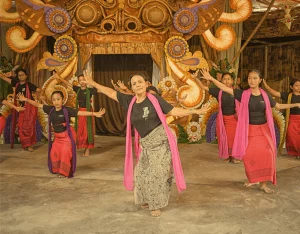
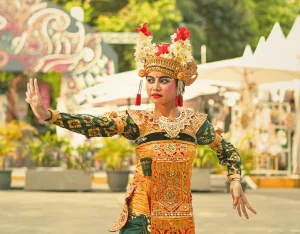
In Balinese dance, every movement carries intention. What appears to be a simple tilt of the head, a flick of the wrist, or a shift in posture is actually shaped by centuries of tradition and cultural meaning. For the Balinese, gestures are more than decorative; they reflect respect, devotion, and the philosophy of the island’s artistic heritage. But what cultural rules guide these gestures, and why do they hold such importance in every Balinese performance?
Gestures with Purpose: The Meaning Behind Each Movement
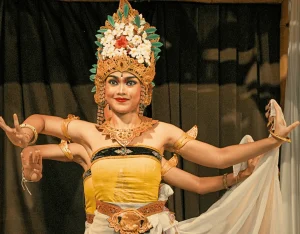
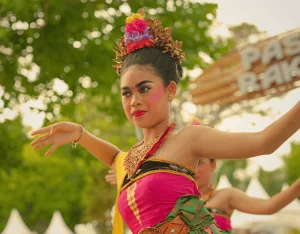
Balinese dance is built upon a foundation of highly structured gestures. Nothing is improvised, and nothing is accidental. Every hand position, eye movement, and body stance has a purpose shaped by ritual, mythology, and symbolism. A dancer’s eyes express emotion and intention through seledet, sharp glances that communicate character and mood. The hands form mudra-like gestures that symbolize nature, spirits, or specific narrative elements. Even the angle of the shoulders or the grounding of the feet in agem reflects discipline, identity, and narrative flow. Through these precise gestures, dancers communicate without speaking, inviting audiences into a world where meaning is carried through movement.
Cultural Etiquette That Preserves Sacred Tradition
Because these gestures hold deep cultural value, there are unwritten rules that dancers follow each time they perform. A dancer begins with a grounded awareness, acknowledging the sacredness of the space and the purpose of the performance. Movements must be executed with clarity, intention, and respect, as many of them originate from offerings to the gods or stories tied to religious ceremonies.
Certain gestures cannot be altered freely, especially when performing sacred dances that are linked to temple rituals. Tradition provides structure: how a hand rises, how an expression shifts, and how energy flows through the body all follow guidelines passed from teacher to student. These rules ensure that every performance remains connected to its cultural roots, even as Balinese dance continues to evolve on modern stages.
How These Gestures Connect Performers and Audiences
Despite the detailed rules shaping every movement, the effect is universal. Audiences from around the world feel emotionally connected to the performance even without understanding the specific symbolism. This is because gesture etiquette shapes the emotional clarity of the dance each look, each line of the body, each shift in rhythm communicates directly to the viewer.
Gesture etiquette ensures that the performance is both beautiful and meaningful. It allows the audience to sense the dancer’s intention, to follow the emotional arc of the story, and to feel the energy of the performance. Through this shared experience, Balinese dance becomes a bridge that connects cultures, beliefs, and perspectives.
Honoring the Etiquette of Traditional Movement
At Sawelas Nusantara, gesture etiquette is treated with respect and care. Every dancer is trained to preserve the traditional rules that give Balinese dance its soul. Whether performing for a local ceremony or sharing Bali’s culture with international visitors, the dancers maintain the clarity, discipline, and intention that honor their heritage.
Balinese gesture etiquette reminds us that beauty is most powerful when it carries meaning. It shows that movement can be both disciplined and expressive, spiritual and artistic, ancient and alive.
📍 Visit us at Bali Collection, Jl. ITDC Nusa Dua Lot BC, Benoa, South Kuta, Badung, Bali
📅 Check our Event Schedule and discover the meaning behind every gesture.
In every precise movement, a story of devotion quietly unfolds.